 Mango Postal
Postcard Statistics 2026: Do People Still Send Postcards?
Postcards in 2026 sit in an odd spot. Less mail moves through the post than at any point in decades, yet the people who get a postcard say it means more than ever. These postcard statistics follow that gap: how much snail mail is disappearing, why physical mail still lands, and whether people still send postcards at all.
Short answer: Letter mail is shrinking fast. Canada Post delivered about 2 billion letters in 2025, down from 5.5 billion in 2006. But personal mail remains valuable. 83% of US teens in a 2019 USPS survey said they feel happy when mail arrives, and two in three adults would rather receive a physical card than a digital one.
Mail volume statistics: the mailbox has never been this quiet
In 2006, Canada Post delivered about 5.5 billion letters. In 2025, it delivered about 2 billion. Over the same years the country added 3.6 million new addresses, so the drop per household is even steeper: 70% fewer letters per mailbox than at the peak (Canada Post 2025 Annual Report).
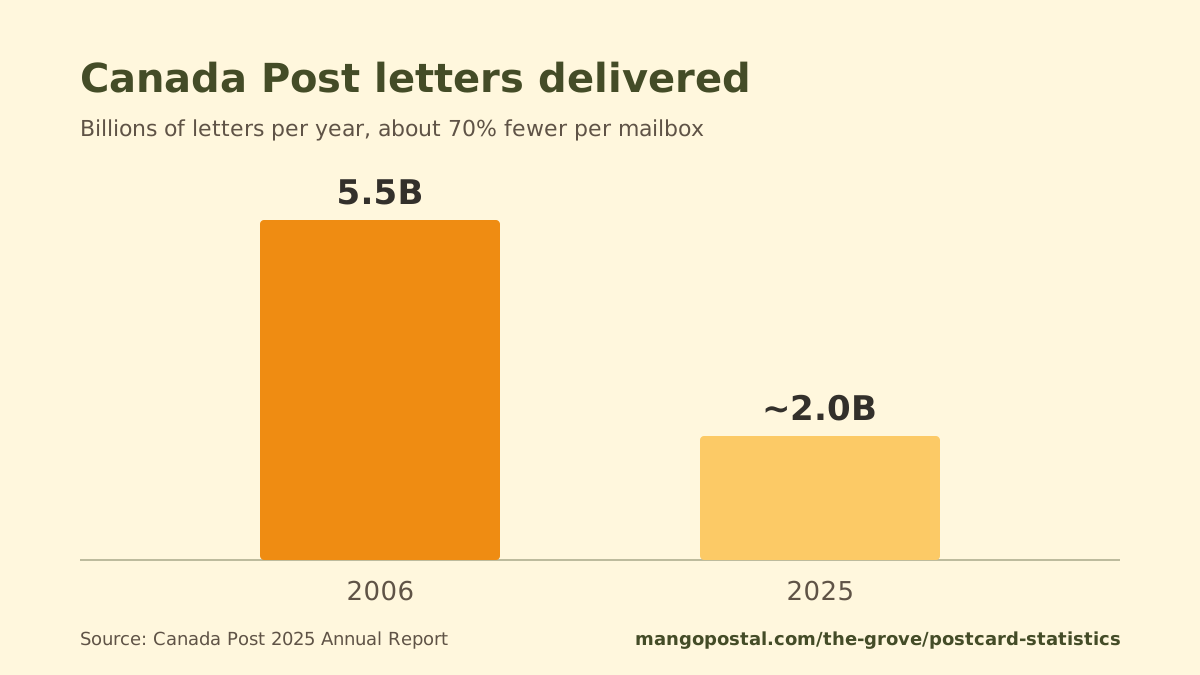
Want to use this chart? Paste this code into your page. It links back here as the source.
<a href="https://www.mangopostal.com/the-grove/postcard-statistics"><img src="https://www.mangopostal.com/the-grove/assets/img/canada-post-letter-decline.svg" width="600" height="338" alt="Bar chart comparing Canada Post letter volume in two years: 5.5 billion letters delivered in 2006 versus about 2.0 billion in 2025, about 70% fewer per mailbox"></a>
<p>Source: <a href="https://www.mangopostal.com/the-grove/postcard-statistics">Postcard Statistics 2026, Mango Postal</a></p>
Total volume is only half the story. Year by year, the number of letters reaching each Canadian household has fallen in a nearly straight line, from 372 pieces in 2006 to 113 in 2025.
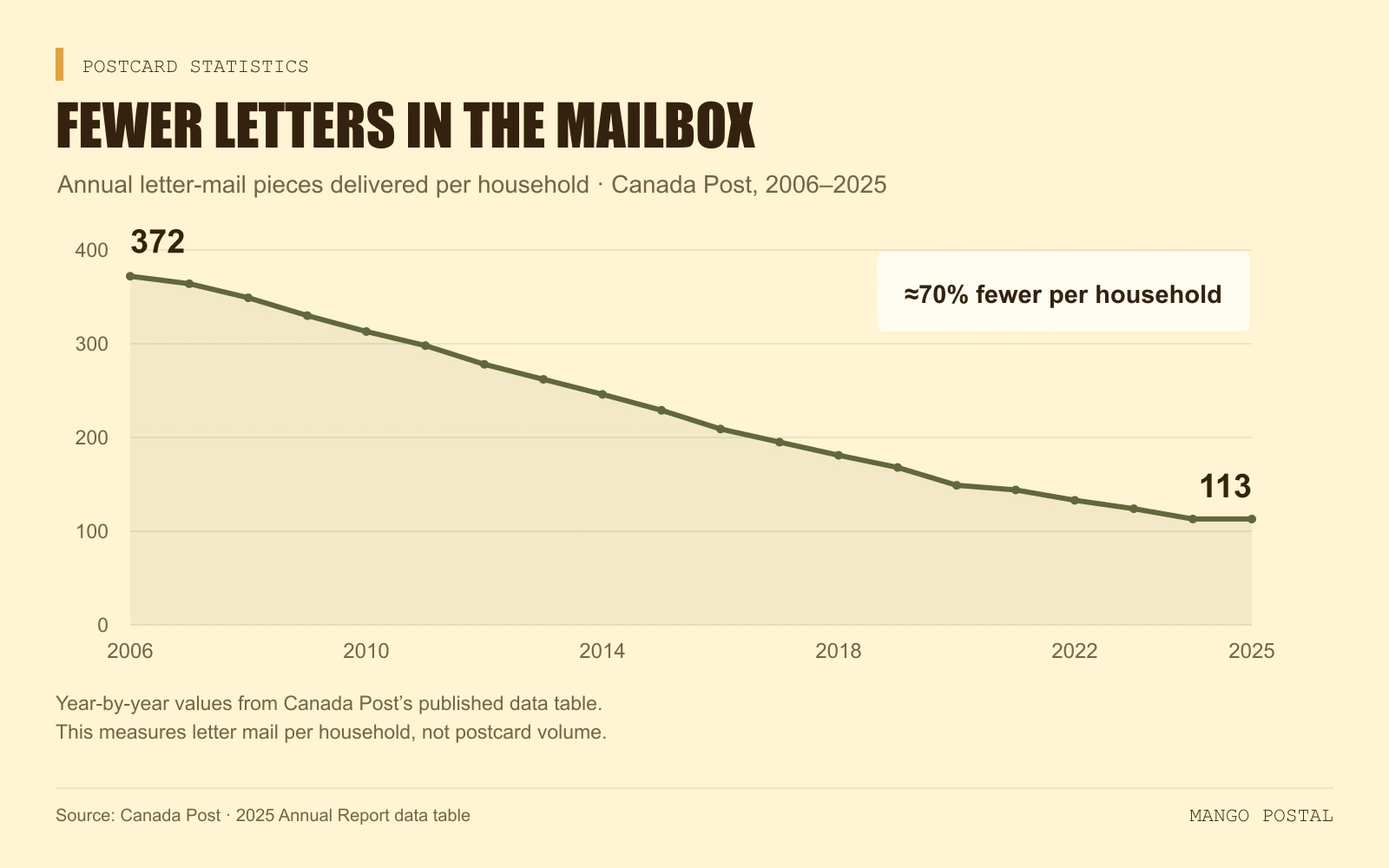
View the data: letter mail per household, 2006–2025
| Year | Letter-mail pieces per household |
|---|---|
| 2006 | 372 |
| 2007 | 364 |
| 2008 | 349 |
| 2009 | 330 |
| 2010 | 313 |
| 2011 | 298 |
| 2012 | 278 |
| 2013 | 262 |
| 2014 | 246 |
| 2015 | 229 |
| 2016 | 209 |
| 2017 | 195 |
| 2018 | 181 |
| 2019 | 168 |
| 2020 | 149 |
| 2021 | 144 |
| 2022 | 133 |
| 2023 | 124 |
| 2024 | 113 |
| 2025 | 113 |
The US tells the same story at a larger scale. USPS carried 42.0 billion pieces of First-Class Mail in fiscal 2025, the category a postcard travels in. That's 2.2 billion fewer pieces than the year before, a 5% drop in a single year (USPS). Total mail volume fell 3.3% to 108.7 billion pieces (Quad).
The postal services are reshaping themselves around that decline. Canada Post lost a record $1.57 billion before tax in 2025. Its proposed plan would end the remaining door-to-door delivery and move those homes to community mailboxes, and most letters would take one to two extra days to arrive.
But look at what actually disappeared. It was mostly bills, bank statements and notices, the mail nobody was excited to open. The personal mail that's left is a much smaller slice, and it's the slice people still care about.
Why send postcards? Because physical mail stands out
When a mailbox holds two flyers and a utility bill, a card with handwriting on it is the first thing that gets picked up. Scarcity has made handwritten mail more noticeable, not less.
People say so when asked. In a 2023 Shutterfly survey of 2,000 US adults, two in three said they'd rather receive a physical card than a digital one, and 54% said they still mail their cards instead of sending them online (Two Sides North America). The same report cites industry research finding that about 80% of people keep cards that mark a milestone in their life or relationship.
There's a reason paper sticks. In a 2015 Canada Post study, researchers used brain imaging and eye tracking on 270 people. Printed mail took 21% less mental effort to process than digital ads, and people remembered the brand 70% more often afterward (75% versus 44%) (Canada Post). The study measured advertising, not personal mail, so it doesn't prove the same holds for a card from a friend. But it does suggest paper holds our attention in a way a screen often doesn't.
A text gets read and buried under the next one. A postcard ends up on the fridge.
Do people still send postcards? Gen Z says yes
You'd expect the generation raised on smartphones to have the least use for snail mail. The data says otherwise.
The USPS Office of Inspector General surveyed 403 US teenagers aged 13 to 18 (fieldwork in late 2019, published 2020). 83% said they feel happy when mail arrives, compared with about 60% who feel that way video chatting. 56% said mail makes them excited; only 29% said the same about email or texts. And 89% said getting a letter or card from friends and family makes them feel special (USPS OIG, Generation Z and the Mail).
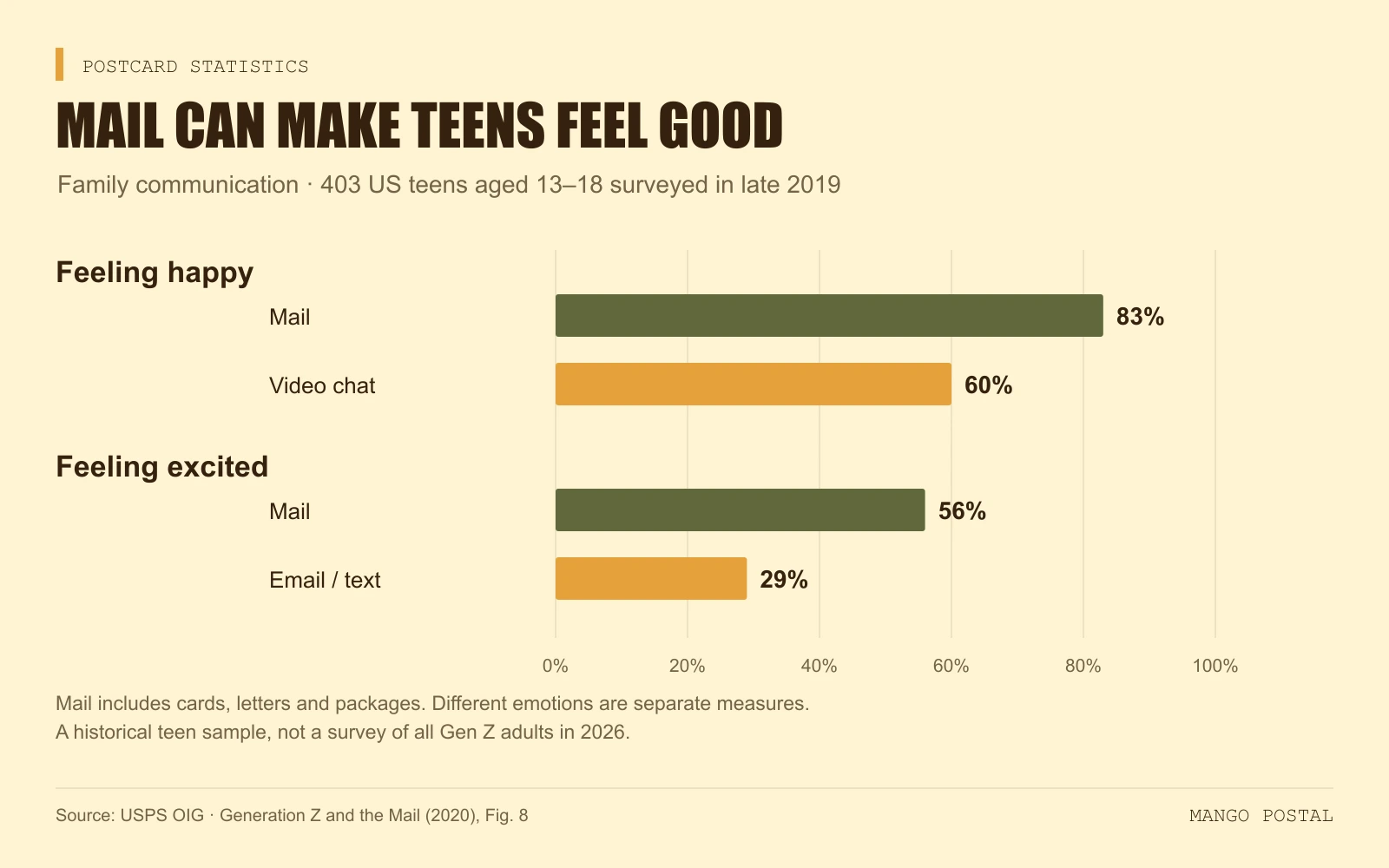
They don't just like receiving it. 64% said they enjoy writing and mailing cards and letters, and nearly two-thirds send a greeting card or postcard at least a few times a year. When they want to congratulate a family member, 18% reach for a card, letter or postcard first. Just 2% pick email. In their own words, mail shows you took the time.
That instinct extends well past teenagers. Postcrossing, a project where strangers mail postcards to each other at random, now has 806,107 members in 207 countries (Postcrossing). Together they've received more than 88.5 million postcards, and around 486,000 are in transit at any moment. The median card takes 21 days to arrive (Postcrossing). A hobby built on waiting three weeks for a stranger's handwriting has close to a million members, which says a lot about what people miss.
Greeting cards point the same way. Americans still buy about 6.5 billion cards a year, worth $7 billion to $8 billion, and USPS research counted more than 2.3 billion greeting cards mailed in a single fiscal year (USPS News). December is the peak: see our Christmas card statistics.
What stops people from sending postcards: stamps, lines and price
If people love getting postcards, why don't they send more? The answer is mostly logistics.
In a 2024 Stamps.com survey, 65% of Americans said they send physical mail one to five times a month, and the personal touch was the most-loved thing about it (37%). But 43% named postage costs as their biggest frustration, and 44% of Gen Z said the time it takes, from finding stamps to standing in line, was their top pain point (Spectrum News).
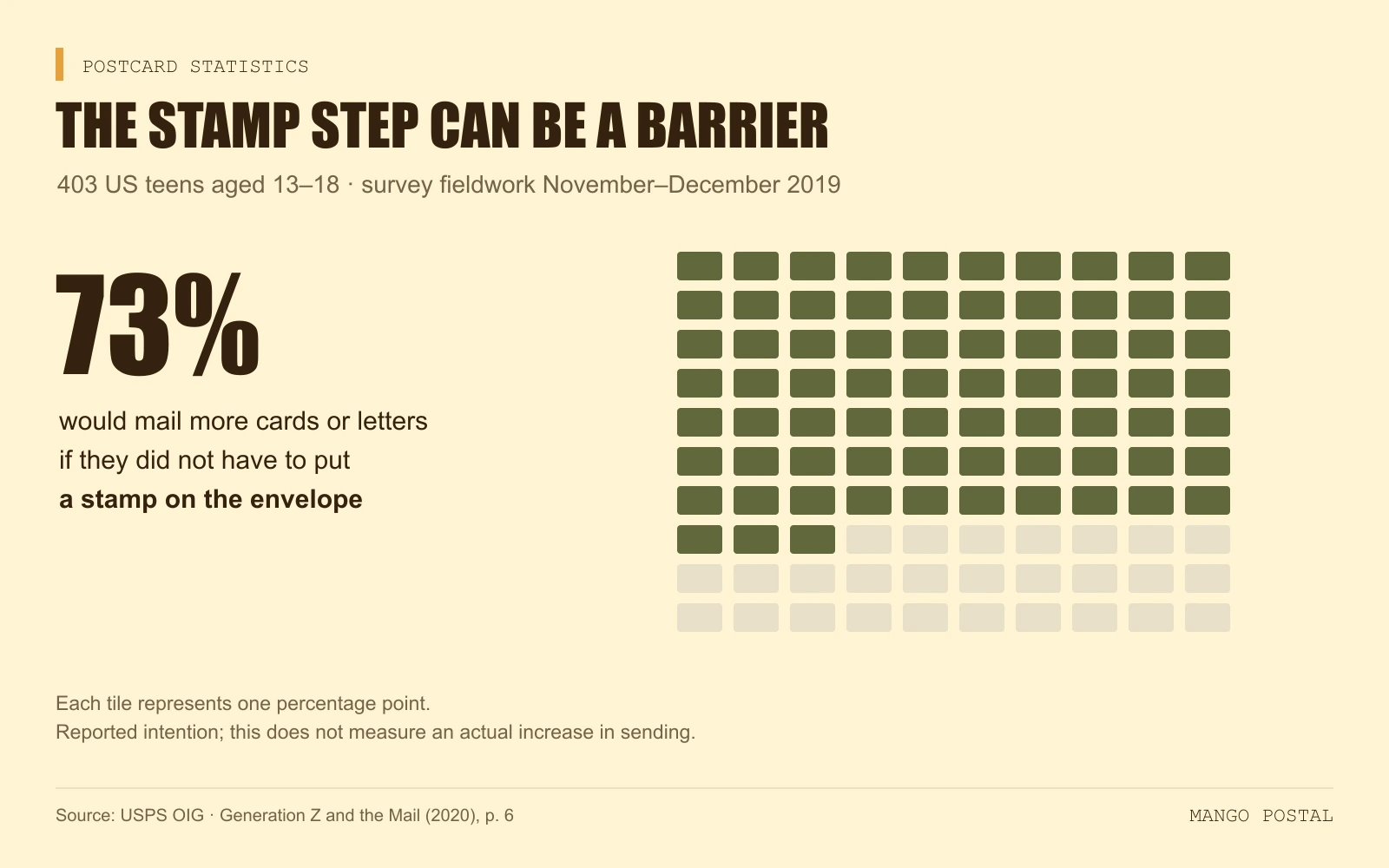
The USPS teen survey found the same thing from another angle: 73% of the teens surveyed said they'd mail more cards and letters if they didn't have to put a stamp on them.
Postcard stamp prices aren't getting cheaper, either. A US postcard stamp rose to $0.65 on July 12, 2026, up from $0.61, and a Forever stamp now costs $0.82, up from $0.55 in 2020 (WFSB / CNN). In Canada, where postcards pay the letter rate, a domestic stamp runs $1.24 CAD in a booklet or $1.44 on its own. (Our full breakdown: How much is a postcard stamp in 2026?)
So the problem was never the postcard. It was the errand around it. That's the gap services that let you send postcards online are built to close: you write the card on your phone, and someone else handles the stamp and the mailbox.
A short history of postcards
It's easy to think of postcards as old-fashioned, but they began as the shortcut. A letter meant paper, an envelope and a full stamp. A postcard was cheap, open and short, the text message of the 1800s.
The oldest known picture postcard dates to 1840, when London writer Theodore Hook painted a card and mailed it to himself, probably as a joke on the post office. It sold at auction in 2002 for a record £31,750 (The Wire / DW). The official postcard arrived on October 1, 1869, in Austria-Hungary: a plain card with no picture, and millions were mailed within the first few months. The idea came from Viennese economist Dr. Emanuel Herrmann, which is why he's usually credited with inventing the postcard.
Canada moved fast. On June 1, 1871, it became the first country outside Europe to issue postcards, and one cent covered both the card and delivery anywhere in the Dominion (Canadian Museum of History). The US followed with its first government postal card in 1873, and in 1898 let private printers make postcards mailed at the same one-cent rate (Smithsonian Institution Archives).
The last piece was the "divided back," the line that lets the message and address share one side so the picture stays clean. Britain allowed it in 1902, Canada in December 1903 and the US on March 1, 1907. Postcards exploded in popularity right after, and collecting cards from that era even has its own name today: deltiology.
What's changed since isn't the postcard. It's everything around it. Now that a text is instant and free, the postcard has flipped roles: it's no longer the quick option, it's the deliberate one. That's exactly what makes it land.
What it means for the next one you send
Put the numbers side by side and the picture is clear. The mailbox is emptier than it has been in generations, and that's exactly why a postcard gets noticed, kept and remembered. The people who receive one, including the youngest generation, say it makes them feel special. The main thing stopping more of them from being sent is the stamp-and-post-office errand, not a lack of interest.
So if someone has been on your mind, a postcard is still one of the simplest ways to say so. It'll probably end up on their fridge.
Postcard statistics and facts at a glance
For anyone who wants to cite a figure, here are the key statistics from this piece. A link back is appreciated.
| Statistic | Number | Source |
|---|---|---|
| Letters Canada Post delivered in 2025 (vs. 2006) | ~2 billion (vs. 5.5 billion) | Canada Post |
| Drop in letters per Canadian address since 2006 | 70% | Canada Post |
| USPS First-Class Mail volume, fiscal 2025 | 42.0 billion pieces (down 5%) | USPS |
| Adults who prefer receiving a physical card | 2 in 3 | Shutterfly, 2023 |
| US teens (13–18) who feel happy when mail arrives | 83% | USPS OIG, 2019 survey |
| US teens (13–18) who say a card or letter makes them feel special | 89% | USPS OIG, 2019 survey |
| US teens (13–18) who'd mail more if they didn't need a stamp | 73% | USPS OIG, 2019 survey |
| Postcards received through Postcrossing | 88,575,742 | Postcrossing, Oct 2026 |
| Greeting cards Americans buy each year | ~6.5 billion | Greeting Card Association |
| US postcard stamp | $0.65 USD | USPS, since July 12, 2026 |
| World's oldest known picture postcard | 1840 | Guinness World Records |
Postcard statistics FAQ
How many postcards are sent each year?
No postal service publishes an official count of personal postcards; they're folded into First-Class Mail and Lettermail totals. The best proxies are Postcrossing (88.5+ million cards exchanged since 2005) and USPS research showing more than 2.3 billion greeting cards mailed in a single year.
Are postcards still popular?
For personal moments, yes. 89% of US teens in a 2019 USPS survey said a card or letter from friends and family makes them feel special, and two in three adults prefer a physical card to a digital one.
Why is mail volume falling if people like postcards?
Most of the decline is bills, statements and business letters moving online. Personal mail is a small share of total volume, and it's the part people still say they enjoy.
What is the oldest postcard in the world?
A hand-painted card Theodore Hook mailed to himself from London in 1840. It's recognized as the oldest known picture postcard.
Do people still send postcards?
Yes. Nearly two-thirds of US teens surveyed by the USPS Office of Inspector General send a greeting card or postcard at least a few times a year, and Postcrossing's 806,000+ members have exchanged more than 88.5 million postcards.
Who invented the postcard, and when was the first one sent?
Austrian economist Dr. Emanuel Herrmann proposed the official postcard, and Austria-Hungary issued the first ones on October 1, 1869. The oldest known picture postcard is older: Theodore Hook mailed one to himself in London in 1840.
Are postcards making a comeback?
Not in overall mail volume, which keeps falling. But interest in personal mail is strong: 64% of US teens surveyed by the USPS Office of Inspector General said they enjoy writing and mailing cards and letters, and 73% said they'd mail more if they didn't need a stamp.
Sources
Written and fact-checked by the Mango Postal Editorial Team. Figures checked against these sources on October 12, 2026. Postcrossing numbers update live, so they'll be slightly higher when you read this.
- Canada Post: 2025 Annual Report, executive summary
- Canada Post: 2025 Annual Report, delivery reach and letter mail data
- USPS: Fiscal Year 2025 results
- Quad: Postal and logistics update, November 2025
- USPS Office of Inspector General: Generation Z and the Mail (2020)
- Two Sides North America: Paper greeting cards are America's calling card
- Canada Post: Neuromarketing study news release (2015)
- Postcrossing: Postcard statistics
- Postcrossing: Member statistics
- USPS News: Greeting card stats released
- Spectrum News: Stamps.com mail survey (2024)
- WFSB / CNN: USPS stamp price increase, July 2026
- The Wire / DW: How the postcard became a hit 150 years ago
- Canadian Museum of History: Canadian postal chronology
- Smithsonian Institution Archives: Postcard history
- Future Museum: Ayrshire on a Postcard (postcard origins)
Make one now
Skip the stamp and the post office line. Design a postcard on your phone, and we'll print it on cotton archival paper and mail it anywhere in Canada or the US.
Build Postcard